NEP@5: AISA’s Ground Report Exposes How NEP is Dismantling Public Education in India
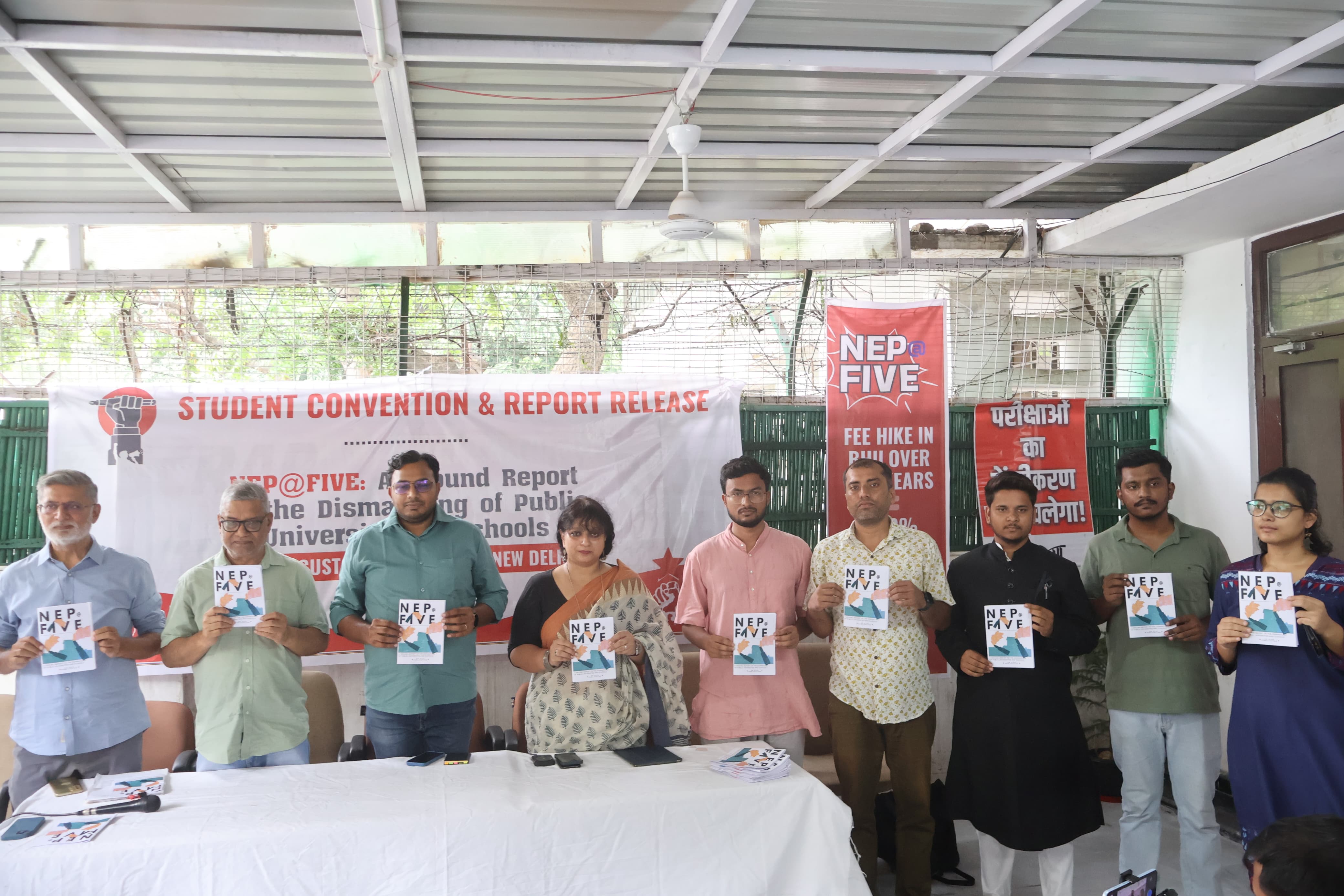
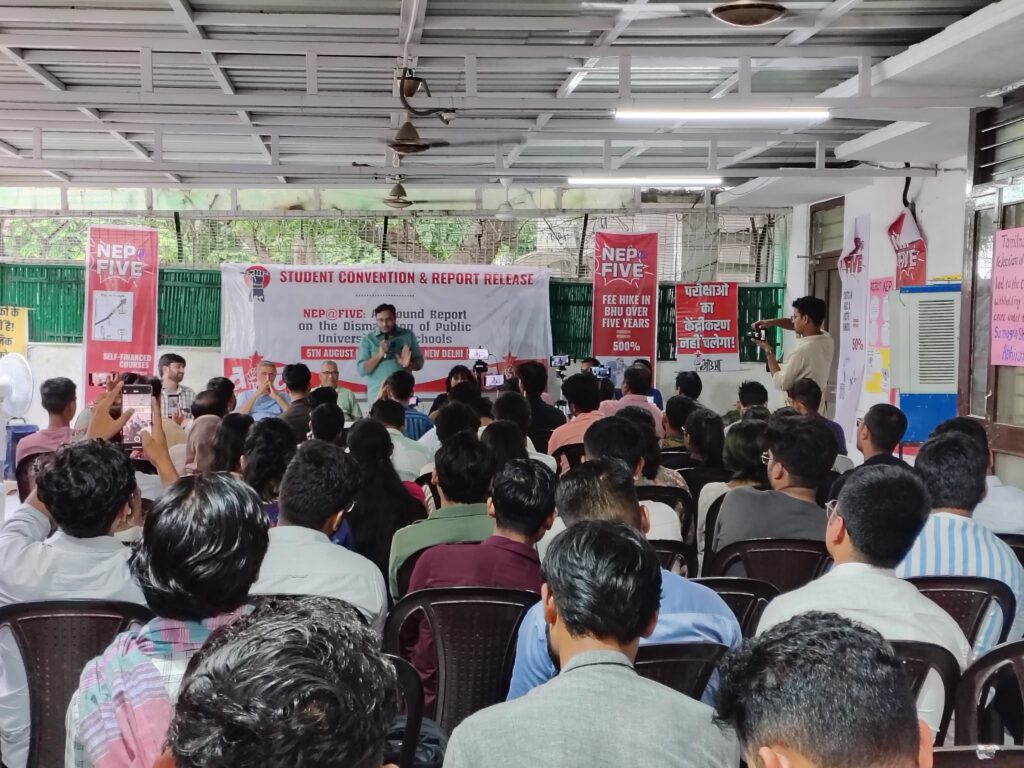
All India Students’ Association (AISA) spearheaded the publication of NEP@Five, a critical ground report examining the disastrous effects of the National Education Policy over the previous five years, in a powerful demonstration of group resistance. The report, which was put together using testimonies and in-depth fieldwork from more than 20 central and state universities in 12 states, emphasises how NEP has exacerbated caste and class divisions, accelerated the decline of public education, and placed the onus of affordability and access on students. Academics and student leaders from JNU, DU, AUD, and AMU- the universities most affected by and therefore at the centre of the resistance- spoke at the convention.
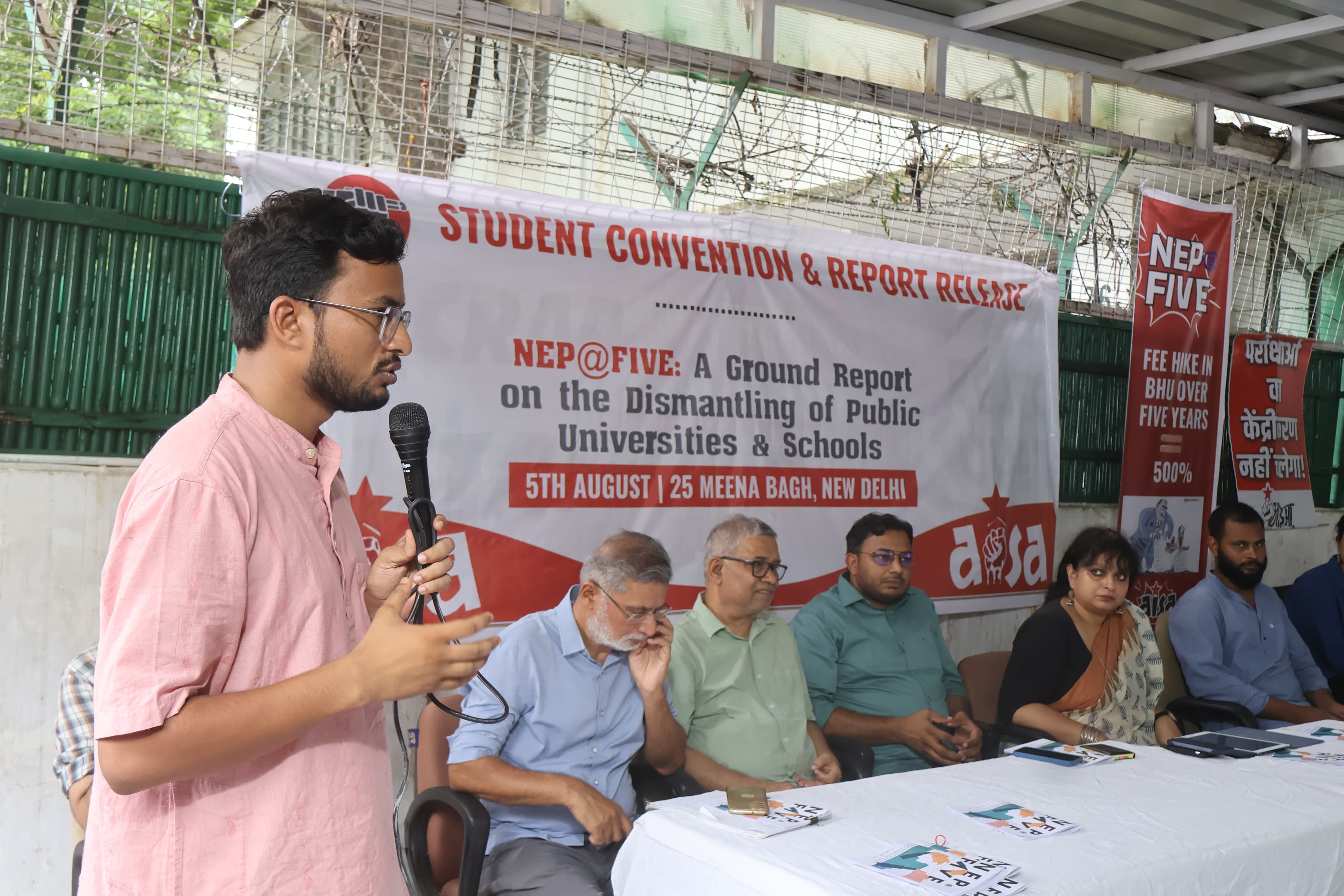
Nitish Kumar, JNUSU President and PhD Scholar, underlined the massive dropout crisis in JNU’s undergraduate programs in the School of Languages due to the hectic FYUP schedule under NEP. He cited JNU’s introduction of self-financed engineering and MBA programs, which are frequently unstructured and inaccessible to the marginalized, as a solution to fee increases that had been thwarted by student dissent. In order to further institutionalise caste and class segregation in Indian education, he underlined that the admission of foreign universities would further exclude underprivileged students who cannot afford elite-level tuition.
Prerna, a PhD Scholar at AUD, talked about how the implementation of AUD has coincided with the taking over of the office by the current ice chancellor Anu Singh Lather. Being the costliest public university in India, AUD has seen a regular annual fee hike by 10%, a change of reservation policy to make it exclusionary, and alterations in the syllabus to slowly let NEP trickle in and become solidified by way of MOOC courses or Bharatiya Knowledge Systems. In the last five years, the faculty and students alike have sustained several attacks in terms of clamping down of voices but also managing to continue to teach and be taught amongst dilapidated and crumbling infrastructure. With a student council that is mostly powerless, the gathering was urged to take the NEP@Five Report to further public and make AUD a case study to prevent further regression of education in India.
Com. Shams from Jamia Millia Islamia’s Comrade drew attention to the increasing repression on campuses, where students are expelled for dissent, and the fact that neither academic quality nor infrastructure has improved despite the university having acquired a hefty ₹532 crore loan from HEFA.
Former DU professor Laxman Yadav gave a forceful critique of the NEP as “No Education for the Poor,” pointing out that 27,000 public schools were closed between 2019 and 2024 while public funds were used for liquor stores and temple renovations. He brought up tragic examples of how educational negligence disproportionately affects marginalised communities, such as the roof collapse of a school in Jhalawar, Rajasthan, which saw the saddening demise of dalit and adivasi students. Professor Yadav further reiterated that “the destruction of education doesn’t happen overnight- it’s a slow, deliberate process. And now, five years into the implementation of the NEP, I can say with absolute certainty, our public education system has been completely and systematically dismantled.”
Professor Atul Sood of JNU raised the question of NEP’s successful despite its glaring shortcomings. He maintained that the policy is a component of a broader state propaganda effort that aims to promote jingoistic narratives and create consent. India ranks fourth in terms of quantity of publications, but 19th in terms of quality, indicating a decline in academic rigour as a result of a system that is becoming more and more reliant on foreign models. He referenced research from the RBI and Chrysalis that demonstrated private universities rely on real estate speculation rather than student tuition to stay afloat.
Using data from the World Economic Forum and the Berstein Report, Sandhya Devesan (DU) pointed out that although 1% of households own 60% of the nation’s GDP, 14 million jobs are expected to be lost by 2027. According to her, the NEP is a modern-day Manusmriti in which privileged students flourish in “safe” academic environments while underprivileged students are forced into “detention centres” of deprivation and exclusion based on the multiple exit points propagated by the FYUP model. Instead of encouraging students to pursue intellectual or research endeavours, the multiple exit policy is a casteist tool that forces them into low-wage, newer forms of slave labour.
It is evident from the NEP@Five Report that India’s educational system is in dire straits. The speakers urged immediate, group opposition to the NEP’s exclusive and polarising structure. In order to protect education as a democratic right and not a privilege, they underlined the necessity of fostering unity among students, teachers, and underrepresented groups.